Genetic catalogue of UrC
This genetic catalogue is a result of a systematic search and review of the scientific literature in PubMed, Web of Science, Embase, Scopus and Cochrane online databases.
Search date: 01/31/2023
For more details please kindly refer to this manuscript (link) and PROSPERO (Nr: CRD42022374155): (link)
An update of published data after 01/31/2023 is ongoing and will be published here
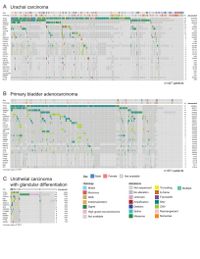
Figure 1) Overview of the genetic alterations in rare adenocarcinomas of urinary bladder. A–C) OncoPrints highlighting mutations in top 30 (urachal and primary bladder adenocarcinomas, A and B, respectively) and top 15 (urothelial carcinoma with glandular differentiation, C) most frequently affected genes. (01/31/2023)
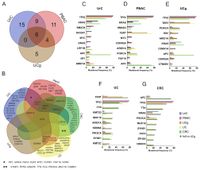
Figure 2) Comparison of the genetic features of bladder malignancies and colorectal carcinoma. A) Venn-diagram showing common and unique frequently affected genes of urachal cancer (UrC), primary bladder adenocarcinoma (PBAC) and urothelial carcinoma with glandular differentiation (UCg). Detailed list of genes is displayed in panel B) Comparison of the genetic features of glandular bladder malignancies and urothelial carcinoma (UC) and colorectal carcinoma (CRC). Analysis was carried out on the top 30 (UrC, PBAC) and top 15 (UCg) most frequently mutated genes. C–G) Comparison of the top 10 most frequently mutated genes of each malignancy to other analyzed cancer types. Columns representing the selected malignancy are marked with boarders. If columns are not displayed that implies 0% mutational rate unless differentiate with asterisks. (last update: 01/31/2023)
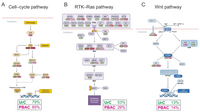
Figure 3) Overview of selected signaling pathways with frequent mutations of urachal carcinoma and primary bladder adenocarcinoma. A–C) Selected signaling pathways (cell-cycle, receptor tyrosine kinase (RTK)–Ras and Wnt pathways) based on Pancancer TCGA dataset and PathwayMapper visual tool [59]. Created in BioRen der. Der, B. (2025) (https://BioRender.com/h75f210, https://BioRender.com/ q73s936, https://BioRender.com/ u94o889). Mutational frequencies in UrC are highlighted with green and PBAC with magenta colors for each gene and for the whole pathway (bottom). (last update: 01/31/2023)
For reference of these data please cite the following article:
Dér B, Váradi M, Nagy N, Kubik A, Paner GP, Iyer G, Gaisa NT, Wobker SE, Bambury R, van Rhijn BWG, Al-Ahmadie H, Nyirády P, Reis H, Szarvas T.
Genetic characteristics and targeted treatments of primary bladder and urachal adenocarcinomas: a systematic review with pooled descriptive genomic analyses
Cancer Metastasis Rev. 2026 May 1;45(2):26. doi: 10.1007/s10555-026-10332-3.
This targeted treatment catalogue is a result of a systematic search and review of the scientific literature in PubMed, Web of Science, Embase, Scopus and Cochrane online databases.
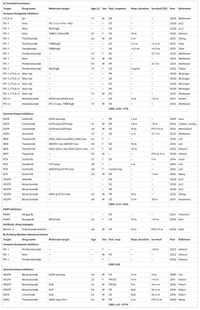
Table 1) Targeted treatment catalogue for urachal cancer and primary bladder adenocarcinoma (last update: 01/31/2023)
 | Download Table1 Table_1.xlsx (78.78KB) |
| Table_1.xlsx (78.78KB) |
| Download Supplementary Table 1 Table_S1.xlsx (17.84KB) |
| Table_S1.xlsx (17.84KB) |
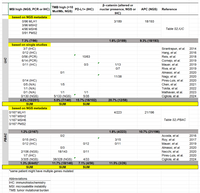
Supplementary Table 3) Therapeutically relevant molecular alterations in urachal cancer and primary bladder adenocarcinoma (last update: 01/31/2023)
| Download Supplementary Table 3 Table_S3.xlsx (13.56KB) |
| Table_S3.xlsx (13.56KB) |
Supplementary Table 4) Detailed Targeted treatment catalogue for urachal cancer and primary bladder adenocarcinoma (last update: 01/31/2023)
| Download Supplementary Table 4 Table_S4_R1.xlsx (23.18KB) |
| Table_S4_R1.xlsx (23.18KB) |
For reference of these data please cite the following article:
Dér B, Váradi M, Nagy N, Kubik A, Paner GP, Iyer G, Gaisa NT, Wobker SE, Bambury R, van Rhijn BWG, Al-Ahmadie H, Nyirády P, Reis H, Szarvas T.
Genetic characteristics and targeted treatments of primary bladder and urachal adenocarcinomas: a systematic review with pooled descriptive genomic analyses
Cancer Metastasis Rev. 2026 May 1;45(2):26. doi: 10.1007/s10555-026-10332-3.